

New York is famous for reinvention. But that reinvention has a cost.
Architect Michael Wyetzner recently examined three extraordinary buildings that once defined the city skyline — and were ultimately demolished. Each was a masterpiece. Each was designed by the legendary firm McKim, Mead & White. And each was lost in the name of “progress.”
Here’s what they were — and what replaced them.
1. The Original Pennsylvania Station (1910–1963)
Before it was replaced by the arena we know today, Penn Station was one of the greatest public spaces ever built in America.
Designed in the Beaux-Arts style, the 1910 station was inspired by:
- The Baths of Caracalla in Ancient Rome
- Bernini’s Piazza in Rome
- Classical Greek Doric columns
Its massive waiting room featured:
- Soaring coffered vaults
- Travertine stone (the same material used in the Roman Colosseum)
- Groin vaults mirrored in both stone and steel
- A monumental scale that dwarfed pedestrians
It wasn’t just beautiful — it was technologically groundbreaking. Engineers had to construct the first tunnels under the Hudson River so trains could enter Manhattan directly. Until then, passengers stopped in Jersey City and crossed by ferry.
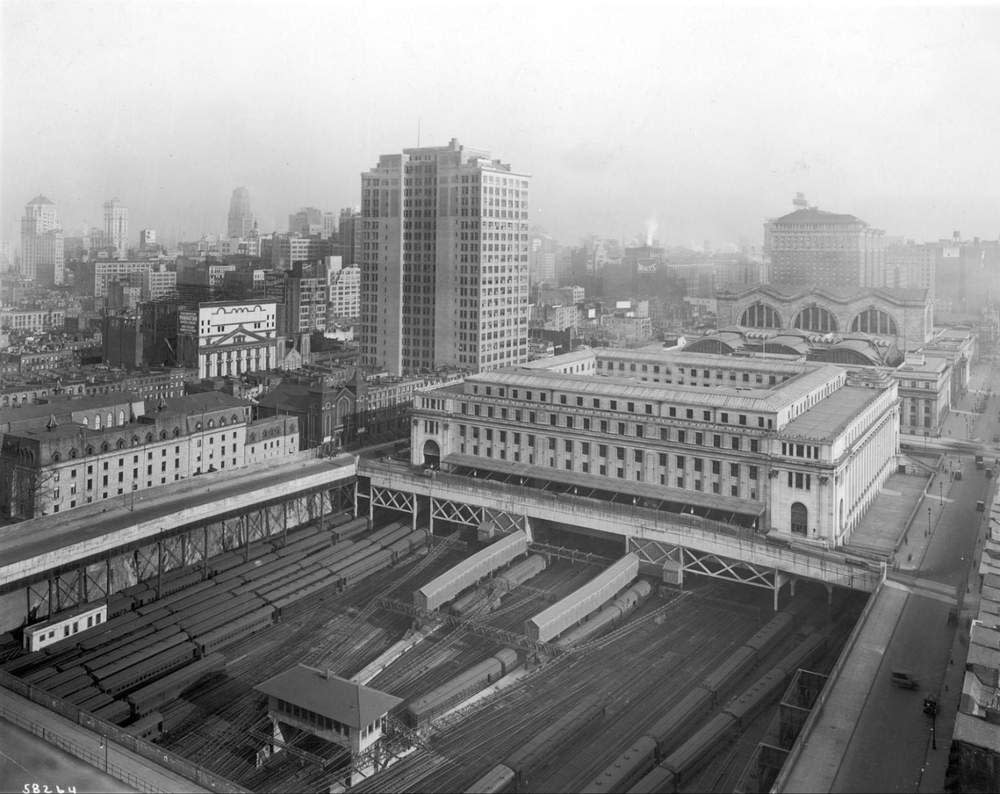
Why It Was Demolished
Unlike many civic monuments, Penn Station was privately owned by the Pennsylvania Railroad. As rail travel declined in the mid-20th century, the company fell into financial trouble and sold the air rights.
In 1963, the station was demolished.
In its place rose:
- The current Madison Square Garden
- An underground Penn Station
The loss sparked outrage and directly led to the creation of New York’s Landmarks Preservation Commission — the agency that later saved Grand Central Terminal from a similar fate.
As The New York Times famously wrote after its destruction:
“We are judged not by the monuments we create but by those we have destroyed.”
2. The Second Madison Square Garden (1890–1925)
Before today’s arena — and before the Penn Station version — there was a Renaissance Revival masterpiece.
Designed by Stanford White of McKim, Mead & White, the 1890 Madison Square Garden occupied a full city block between Park and Madison Avenues.
Architectural highlights included:
- Buff brick façade
- Arched arcades for ticket buyers
- Loggias and terracotta ornament
- Corner domes and mid-block turrets
But the defining feature was its 32-story tower, inspired by the Giralda Campanile in Seville, Spain. At the top stood a gilded statue of Diana, symbolizing entertainment and pleasure — a bold contrast to religious towers that inspired it.
The arena hosted:
- Presidential conventions
- Circus performances
- Boxing matches
- Bicycle races (including a velodrome)
- A sliding skylight — advanced for its time
It was also the site of a notorious murder: Stanford White was shot on its rooftop garden in 1906 by Harry Kendall Thaw, husband of actress Evelyn Nesbit.
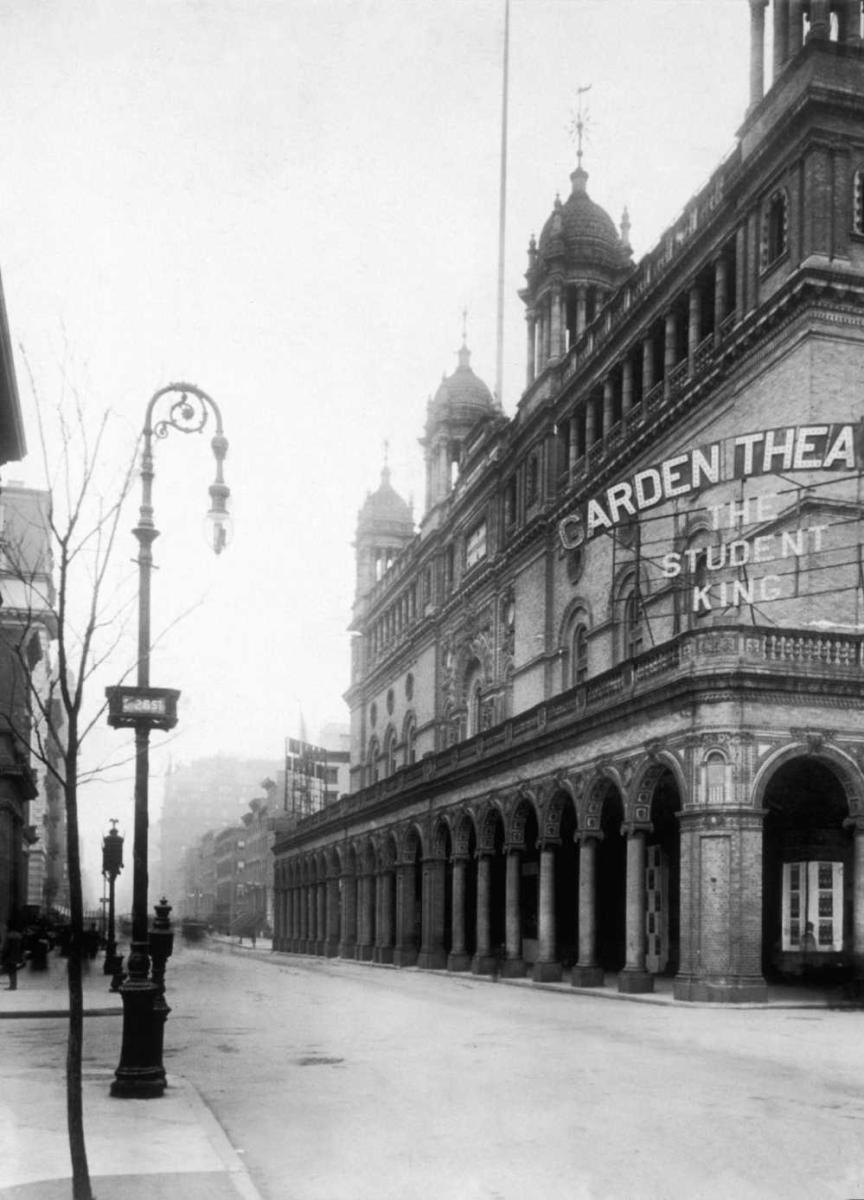
Why It Was Demolished
Financial instability again played a role. The building struggled to generate enough revenue and was demolished in the 1920s.
It was replaced by the still-standing New York Life Insurance Building, crowned with its iconic gold pyramid roof.
3. The New York Herald Building (1894–1930)
Standing at what is now Herald Square, this Stanford White design marked a pivotal shift in Manhattan’s commercial geography.
At the time, newspapers were clustered downtown near City Hall. Publisher James Gordon Bennett Jr. predicted the city’s center of gravity would move north — and built his headquarters at Broadway and Sixth Avenue.
Architectural features included:
- Venetian Renaissance inspiration
- A semicircular recessed arcade
- Terracotta ornament between windows
- A trapezoidal footprint
- A plaza in front — now known as Herald Square
Above the façade stood statues of:
- Minerva
- “Bell ringers” representing printing press workers
- Owls with glowing green electric eyes (a nod to journalistic wisdom)
The design drew heavily from Italy’s Loggia del Consiglio in Verona, itself influenced by Brunelleschi’s Florentine hospital.

Why It Was Demolished
By 1930, it too was torn down.
Unlike Penn Station or Madison Square Garden, it wasn’t replaced by something iconic. Instead, an ordinary commercial office building now occupies the site, housing retail at street level.
Fragments survive — Minerva and decorative elements still appear in Herald Square — but the structure itself is gone.
The Pattern: Progress Over Preservation
At the turn of the 20th century, New York embraced a philosophy of relentless growth. Buildings were not sacred; they were temporary.
But Penn Station’s destruction changed that. Public backlash gave birth to the preservation movement. Today, many structures are protected because of what was lost.
Had preservation laws existed earlier:
- The original Penn Station might still stand.
- The second Madison Square Garden might still define Madison Square.
- Herald Square might look radically different.
New York is defined by ambition — but also by absence.
The city we see today isn’t just shaped by what was built.
It’s shaped by what was torn down.